
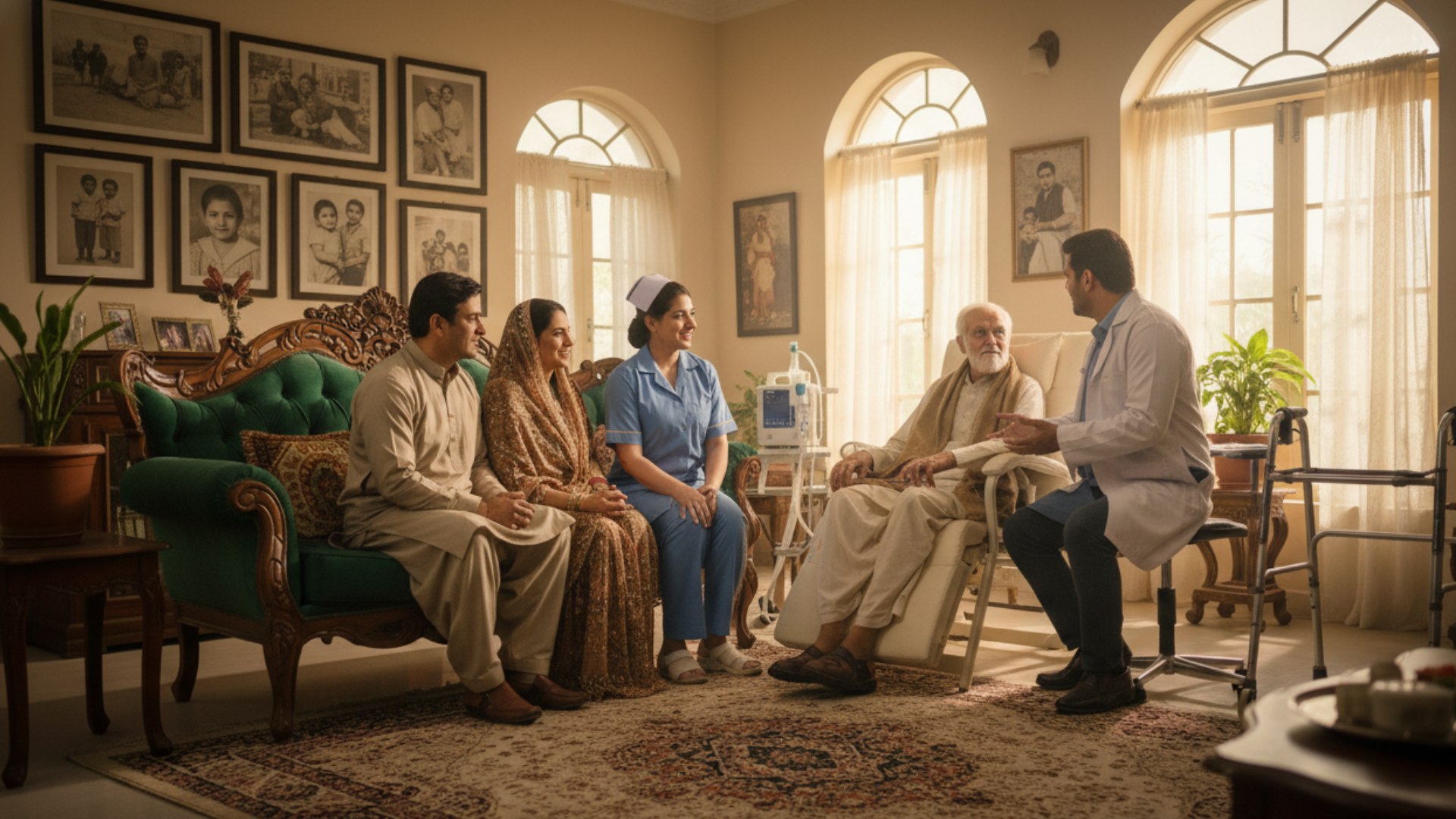
The Changing Face of Healthcare in Karachi
Karachi, the City of Lights, is a metropolis that never sleeps. It is the economic engine of Pakistan, home to over 20 million people. From the high-rise apartments of Clifton and Emaar to the bustling streets of North Nazimabad and Gulshan-e-Iqbal, life here is fast, demanding, and often chaotic.
In this relentless pace of life, there is one reality that brings everything to a screeching halt: Sickness in the Family.
Whether it is an elderly parent suffering from a sudden stroke, a young family member recovering from a road accident, or a loved one battling a chronic illness like cancer, a medical crisis changes the entire dynamic of a household. For decades, the only solution was the hospital. Families would rush to Aga Khan University Hospital (AKUH), Liaquat National, or South City, spending days and nights on uncomfortable attendant benches, navigating traffic, and paying exorbitant room charges.
But in 2026, the healthcare landscape in Karachi has shifted.
We are witnessing a massive transition from “Hospital-Based Care” to “Karachi Home Nursing”. Families are realizing that while hospitals are necessary for surgery and acute emergencies, the process of healing happens best at home.
Elsa Home Nursing Care stands at the forefront of this revolution. We are not just a service provider; we are a partner in your family’s health journey. This comprehensive, guide is the most detailed resource available on the web regarding patient care services in Karachi.
Whether you are looking for a skilled nurse for ICU-level care, a compassionate attendant for elderly care services, or simply trying to understand the difference between a nursing home in Karachi and home-based care, this guide covers it all.
Chapter 1: What is Home Patient Care? Understanding the Concept
Before we dive into the specifics, it is essential to understand what home patient care actually entails. Many people in Karachi confuse a “Home Nurse” with a “Maasi” (domestic helper). This misconception often leads to poor care and medical complications.
Defining Professional Home Care
Home patient care services refer to a wide range of healthcare services that can be given in your home for an illness or injury. Ideally, home health care is usually less expensive, more convenient, and just as effective as the care you get in a hospital or skilled nursing facility (SNF).
It is a bridge between the hospital and full recovery. It involves:
- Clinical Medical Care: Administered by certified nurses (PNC registered).
- Personal Care: Assistance with daily living activities (ADLs) provided by trained caregivers.
- Rehabilitation: Physiotherapy and speech therapy at home.
The “Hospital at Home” Model
Imagine transforming your bedroom into a private ward.
- Instead of a hospital bed, you have a medical bed in your lounge.
- Instead of a communal nurse managing 10 patients, you have a dedicated nurse focusing only on your loved one.
- Instead of hospital food, the patient eats fresh, home-cooked meals tailored to their diet plan.
This is not a luxury anymore; it is a necessity for infection control and mental well-being.
Chapter 2: Why Karachi Needs Home Nursing Now More Than Ever?
Why is there such a sudden surge in demand for patient care services in Karachi? The reasons are deeply rooted in the city’s unique socio-economic and infrastructural challenges.
1. The Breakdown of the Joint Family System
Historically, Pakistani families lived in large joint systems where if one person fell sick, there were four others to look after them. Today, in areas like DHA and PECHS, we see more nuclear families. Often, both the husband and wife are working.
When an elderly parent falls sick, the children are torn between their careers (which pay the medical bills) and their duty to care for their parents. Home patient care professionals fill this gap, allowing children to work while ensuring their parents are in safe hands.
2. The Traffic and Logistics Nightmare
Transporting a bedridden or wheelchair-bound patient in Karachi is a logistical nightmare.
- Imagine taking a stroke patient from Gulistan-e-Jauhar to Stadium Road for a daily injection or physiotherapy session.
- The traffic jams, the potholes, and the sheer exhaustion of travel can worsen the patient’s condition.
- Home services eliminate this travel entirely.
3. Hospital-Acquired Infections (HAIs)
Post-COVID-19, families are terrified of hospitals. Hospitals are breeding grounds for “Superbugs”—bacteria that are resistant to antibiotics. An elderly patient admitted for a simple fracture might catch a severe chest infection (Pneumonia) from the patient in the next bed.
At home, the risk of cross-infection is nearly zero.
4. Cost-Effectiveness
Let’s do a quick math:
- Private Hospital Room: Rs. 15,000 – 25,000 per day.
- Nursing Charges: Rs. 5,000 per day.
- Total: Rs. 20,000 – 30,000 per day (excluding medicines).
- Elsa Home Nursing: A fraction of this cost for dedicated 24/7 care.
For long-term conditions (like Coma or Paralysis), hospital care allows families to go bankrupt. Home care is sustainable.
Chapter 3: Detailed Breakdown of Services Offered by Elsa Home Nursing
When you search for Karachi Home Nursing, you will find various providers. However, clarity is key. You need to know exactly what kind of staff you are hiring. We categorize our services into three distinct tiers to match your specific needs.
1. Critical Care Nursing (ICU at Home)
This is the highest level of home patient care. These are not just attendants; these are specialized nurses with diplomas or degrees in nursing (BSN/General Nursing).
Who needs this?
- Patients on Ventilators or BiPAP machines.
- Patients with Tracheostomy (throat tube).
- Post-surgical patients (Cardiac bypass, Cancer surgery).
- Patients requiring IV medication management and vital monitoring every hour.
What does the Critical Care Nurse do?
- Airway Management: Suctioning phlegm from the throat to prevent choking.
- Medication Administration: Managing complex IV pumps and injections.
- Wound Care: Dressing deep surgical wounds or Bedsores (Stage 3 & 4).
- Catheter & NG Tube Care: Preventing infections in urinary and feeding tubes.
Read our detailed guide on Ryles Tube Feeding to understand the complexity of this task.
2. Patient Care Assistants (PCA) / Nursing Assistants
This is the most popular service in Karachi. These professionals are trained in basic nursing skills but are focused more on hygiene and mobility.
Who needs this?
- Bedridden elderly patients.
- Stroke patients recovering mobility.
- Patients with fractures (Hip/Leg).
Responsibilities:
- Personal Hygiene: Bed bath (Sponge bath), changing diapers, grooming (nails/hair).
- Mobility: Helping the patient move from bed to wheelchair (Transferring).
- Vitals Monitoring: Checking BP, Sugar, and Temperature and reporting to the doctor.
- Feeding: Assisting with oral feeding or basic tube feeding.
3. Elderly Care & Companionship (The “Nursing Home” Alternative)
There is a rising search for “Nursing Home Karachi” on Google. However, in Pakistani culture, sending parents to an “Old Age Home” is considered a last resort and often carries a stigma of abandonment.
Elsa Home Nursing Care offers a dignified alternative: Assisted Living at Home.
The Concept:
Instead of sending your parents away, we bring the care to them. Our Elderly Care Companions are trained in Geriatric (Old Age) psychology.
What do they do?
- Dementia Support: Managing memory loss, repetition, and confusion with patience.
- Fall Prevention: Being a shadow to the elderly to ensure they don’t slip in the washroom.
- Medication Management: Ensuring they take the right pill at the right time.
- Emotional Support: Talking to them, reading the newspaper, and reducing their loneliness.
Learn more about our approach to Elderly Depression and Anxiety.
Chapter 4: Specializations – Disease-Specific Care at Home
Home patient care services are not “one size fits all.” A cancer patient has different needs than a stroke patient. At Elsa, we train our staff in disease-specific modules.
1. Stroke (Falij) Rehabilitation Care
A stroke changes a life in seconds. The journey from being bedridden to walking again happens at home, not in the hospital.
- The Goal: Neuroplasticity (rewiring the brain).
- Our Approach: Our nurses work in tandem with Physiotherapists. They ensure the patient is positioned correctly every 2 hours to prevent stiffness (spasticity). They manage Dysphagia (swallowing difficulties) to prevent food from entering the lungs.
2. Oncology (Cancer) & Palliative Care
Cancer treatment is aggressive. Chemotherapy leaves the patient weak, nauseous, and immune-compromised.
- The Goal: Symptom management and comfort.
- Our Approach: We manage pain “by the clock.” We care for the “Port-a-Cath” (chemo port). We provide a special diet to combat weight loss.
- End-of-Life Care: When the doctors say “no more treatment,” our Palliative team ensures the patient’s final days are painless, dignified, and spent with family, not machines.
Read our case study on Stage 4 Cancer Pain Management.
3. Post-Operative Surgical Care
After surgeries like Hip Replacement, C-Section, or Abdominal surgeries, the first week at home is painful and risky.
- The Goal: Preventing infection and DVT (blood clots).
- Our Approach: We perform sterile dressing changes. We ensure the patient wears compression stockings. We administer blood-thinning injections (Clexane/Xarelto) safely.
Chapter 5: Home Nursing vs. Nursing Homes in Karachi
This is a sensitive topic. Many families, overwhelmed by the burden of care, consider a nursing home in Karachi. While there are some reputable facilities (like Dar-ul-Sukun for the destitute), private nursing homes for the affluent are rare and culturally frowned upon.
Let’s compare the two options objectively.
Option A: The Nursing Home (Facility-Based Care)
- Pros: 24/7 medical supervision, social interaction with other seniors.
- Cons:
- Loss of Dignity: The elderly often feel “discarded.”
- Rigid Routine: They must eat and sleep according to the facility’s schedule, not their own.
- Infection Risk: Living in a communal environment increases the risk of spreading viruses.
- Cost: High-end facilities charge massive monthly fees.
Option B: Home Patient Care (Elsa Model)
- Pros:
- Comfort: They sleep in their own bed, look at their own walls, and eat their own food.
- Personalized: One-on-one attention. The nurse knows exactly how much sugar they like in their tea.
- Family Bond: They remain surrounded by children and grandchildren, which is the biggest antidepressant.
- Flexibility: You can hire care for 12 hours or 24 hours as needed.
- Cons: You have to manage the staff within your home privacy (which requires a trustworthy agency like Elsa).
The Verdict:
For Pakistani families, Home Nursing is almost always the superior choice emotionally and medically, provided you have the right space at home.
Chapter 6: The “Elsa Standard” – Safety and Verification
One of the biggest fears families in Karachi have is security.
“Is it safe to let a stranger into my house?”
“What if the nurse steals?”
“What if they abuse the patient?”
These are valid fears. The market is flooded with “unregistered agencies” operating from Facebook pages with no office and no verification.
How Elsa Ensures Safety
We operate with the rigorous standards of a corporate healthcare entity.
- NADRA Verification: Every staff member’s CNIC is verified.
- Police Background Check: We conduct background checks to ensure no criminal record.
- Medical Screening: Our staff undergoes screening for Hepatitis B, C, and HIV to ensure they don’t infect your vulnerable patient.
- GPS Tracking: We know where our staff is deployed.
- Supervisor Visits: Our senior supervisors conduct surprise visits to your home to check if the nurse is in uniform, if the patient is clean, and if protocols are being followed.
Read about our Patient-Caregiver Bond to understand how we train staff in soft skills.
Chapter 7: The Financial Breakdown: Cost of Home Nursing vs. Hospital Care in Karachi
One of the first questions families ask when considering patient care services in Karachi is: “Kitna kharcha aayega?” (How much will it cost?).
In a city where inflation is high, managing healthcare expenses is a significant concern. Many assume that hiring a private nurse at home is a luxury reserved for the elite in DHA or Clifton.
However, when you compare it to the cost of a long-term hospital stay, home patient care is surprisingly affordable and offers better value for money.
Let’s break down the costs realistically for 2026.
The Hidden Costs of Hospitalization
When a patient is admitted to a private hospital like Aga Khan or South City for chronic care (e.g., stroke recovery or palliative care), the bill isn’t just the room rent.
- Room Charges: Rs. 15,000 – 35,000 per day (Private/Semi-Private).
- Nursing & Service Charges: Rs. 5,000 – 8,000 per day.
- Doctor Visits: Rs. 3,000 – 6,000 per visit.
- Meals & Medications: Hospital pharmacies charge a premium.
- Attendant Costs: The family member staying with the patient often loses wages or incurs travel/food expenses (approx. Rs. 2,000/day).
Total Estimated Monthly Cost (Hospital): Rs. 600,000 – Rs. 1,200,000+
The Cost of Home Nursing with Elsa Care
Now, let’s look at the home care model.
- 12-Hour Nursing Shift: Rs. 2,000 – 4,500 per day (depending on qualification).
- 24-Hour Live-In Nurse: Rs. 4,000 – 7,500 per day.
- Doctor Visits (Weekly): Rs. 3,000 per visit.
- Medical Equipment Rental: One-time deposit + small monthly rent (e.g., Oxygen machine Rs. 15,000/month).
- Medication: Bought at market rates from local pharmacies (Kausar Medico/Time Medico).
- Food: Home-cooked (Minimal extra cost).
Total Estimated Monthly Cost (Home Nursing): Rs. 100,000 – Rs. 250,000
The Verdict:
Home nursing in Karachi saves you 70% to 80% compared to hospital care for long-term patients.
More importantly, you pay for personalized care. In a hospital, you pay for the facility; at home, you pay for the person caring for your loved one.
For a detailed breakdown of specific procedures, check our Home Nurse Fees in Karachi guide.
Chapter 8: Essential Medical Equipment for Home Care
To turn your bedroom into a functional “mini-hospital,” you don’t need to buy expensive machinery. Most equipment in Karachi is available on rent.
Here is the checklist of what you might need based on the patient’s condition.
1. The Hospital Bed (The Foundation)
A standard master bed is not suitable for a bedridden patient.
- Why: It is too low for caregivers (causing back pain) and doesn’t allow the patient to sit up at 45-90 degrees for feeding.
- Solution: Rent a Manual or Electric Hospital Bed.
- Manual: Has cranks to lift the head and foot side. (Cheaper).
- Electric: Operated by a remote. The patient can adjust their own position, giving them independence.
- Karachi Tip: Ensure the bed has side rails to prevent falls.
2. Oxygen Therapy Equipment
For patients with COPD, Asthma, or post-COVID lung damage.
- Oxygen Cylinder: Good for backup during load shedding or emergency transport. (Refilling is a hassle).
- Oxygen Concentrator: An electric machine that makes oxygen from room air. Best for 24/7 use.
- Warning: In Karachi, always have a UPS backup for the concentrator due to power outages.
Confused between the two? Read our Oxygen Concentrator vs. Cylinder comparison.
3. Air Mattress (Anti-Bedsore Mattress)
If the patient cannot move, this is mandatory.
- How it works: It has air bubbles that inflate and deflate alternately, shifting pressure points on the body to prevent bedsores.
- Types: Bubble type (for prevention) vs. Tubular type (for treatment of existing sores).
4. Suction Machine
For patients with a tracheostomy or those who cannot cough up phlegm (stroke/coma).
- Usage: To suck out mucus from the throat to prevent choking and pneumonia.
- Hygiene: The jar must be cleaned daily to prevent bacterial growth.
Learn how to use it safely in our Suction Machine Guide.
5. Patient Monitor (Multipara Monitor)
For critical patients, this small screen displays Heart Rate, BP, Oxygen Saturation (SpO2), and ECG continuously.
- Benefit: The nurse can spot a drop in oxygen or a spike in BP instantly and alert the doctor.
Elsa Rental Services:
We provide all this equipment on a rental basis. We deliver, install, and train your family on how to use it. No need to visit Lucky Star or Saddar markets yourself.
Chapter 9: The Role of Physiotherapy in Home Recovery
Many families think, “We have a nurse, that’s enough.”
This is a mistake.
A nurse maintains health, but a Physiotherapist restores function.
For stroke, fracture, or paralysis patients, nursing alone will keep them alive, but physiotherapy will get them moving.
Why Home Physiotherapy?
- Convenience: Travelling to a rehab center in a wheelchair is exhausting and painful.
- Consistency: Recovery requires daily exercise. Missing sessions due to traffic or rain delays progress.
- Environment-Specific Training: The physio teaches the patient how to navigate their specific home (e.g., how to get into their specific bathroom or climb their specific stairs).
Common Conditions Treated at Home:
- Stroke Rehab: Relearning to walk, balance training, and hand function recovery.
- Post-Hip/Knee Replacement: Strengthening muscles to support the new joint.
- Frozen Shoulder/Back Pain: Pain management using TENS machines and manual therapy.
- Chest Physiotherapy: For bedridden patients to clear lungs and improve breathing.
Read our success story on Stroke Recovery at Home.
Chapter 10: The Doctor at Home – Managing Medical Decisions
Nursing care needs medical direction. In a hospital, the Resident Medical Officer (RMO) rounds twice a day. At home, who makes the decisions?
This is where Elsa’s Doctor Home Visit service bridges the gap.
The “Family Doctor” Model 2.0
We don’t just send a nurse; we assign a Case Manager (usually a Senior GP) to oversee the patient.
- Weekly Visits: The doctor visits to check the patient’s lungs, wound healing, and general condition.
- Medication Review: They adjust dosages (e.g., reducing BP medicine if BP is consistently low).
- Lab Tests: They prescribe necessary blood tests, which are collected from home.
- Emergency Triage: If the patient gets sick at 2 AM, the nurse calls the doctor first, not the ambulance, to decide the best course of action.
Unsure when to call a doctor vs. ambulance? Read our Night-Time Emergency Guide.
Chapter 11: Nutrition and Diet Planning for Home Patients
“You are what you eat.” This is especially true for sick patients.
In Pakistani households, we love to feed our sick family members rich foods like Yakhni (broth), Khichdi, and Custard. While good, these may not meet the specific nutritional needs of a recovering body.
The “Elsa Nutrition Protocol”
1. For Bedsores & Wound Healing:
- Need: High Protein + Vitamin C.
- Diet: Egg whites, fish, chicken breast, and citrus juices.
- Supplement: Protein powders (like Ensure) if they can’t eat solid food.
2. For Kidney Patients (Dialysis):
- Restriction: Low Potassium, Low Sodium, Fluid Restriction.
- Avoid: Bananas, tomatoes, spinach, and salt.
- Monitor: Daily fluid intake must be measured strictly to prevent lung congestion.
Read our Kidney Patient Diet Guide.
3. For Tube Feeding (NG Tube/PEG):
- Hygiene: Blenderized food spoils quickly in Karachi heat. It must be prepared fresh every 4-6 hours.
- Consistency: Must be watery enough to pass through the tube without blocking it.
- Position: Patient must be propped up at 45 degrees for 1 hour after feeding to prevent aspiration (pneumonia).
Chapter 12: How to Hire the Right Home Nursing Service in Karachi?
Searching for “patient care services in Karachi” on Google or Facebook yields hundreds of results. From individual agents to large companies, how do you choose?
Hiring the wrong service can lead to theft, negligence, or worse.
The 5-Step Hiring Checklist
1. Verify the Company’s Physical Existence:
Do they have an office? Or are they just a mobile number? Visit their office if possible. Elsa Home Nursing has a registered office in Karachi where you can meet our team.
2. Ask for Qualification Proof:
Don’t just take their word. Ask to see the nurse’s PNC (Pakistan Nursing Council) card or diploma copy.
- Warning: Many “nurses” are actually just “dispensers” or untrained helpers.
3. Replacement Policy:
What happens if the nurse is sick or doesn’t show up?
- Freelancer: You are stuck.
- Elsa: We guarantee a replacement within 2 hours. Your care never stops.
4. Supervision Mechanism:
Who checks the nurse?
- A professional agency sends a supervisor for surprise visits. An agent just takes their commission and disappears.
5. Trial Period:
Ask for a 2-day paid trial. See if the nurse bonds with the patient. Does the patient feel comfortable? Does the nurse respect your home rules?
Chapter 13: The Emotional Side of Caregiving (The “Burnout” Factor)
When we talk about patient care services in Karachi, we often focus on the patient: their medicines, their diet, their hygiene. But there is another person in this equation who is often suffering silently: You, the Family Caregiver.
Whether you are a son juggling a corporate job, a daughter managing her own household, or a spouse watching your partner of 40 years fade away, caregiving takes a massive emotional toll.
Understanding “Caregiver Burnout”
It starts with fatigue. You stop seeing friends. You stop sleeping properly because you are listening for the patient’s calls at night. Eventually, it turns into irritability, resentment, and guilt.
“Why am I angry at my sick mother?” you might ask yourself.
This is Caregiver Burnout. It is real, and it is dangerous for both you and the patient.
How Elsa Home Nursing Helps (The “Respite Care” Model)
You cannot pour from an empty cup. To care for your parent, you must care for yourself first.
Elsa Home Nursing Care offers a solution called Respite Care.
- The Concept: You hire a professional nurse not because you can’t do the work, but because you need a break.
- How it works: Hire a nurse for just 2-3 days a week, or for night shifts only.
- Night Shift: The nurse handles the diaper changes, water, and medication at 3 AM. You get 8 hours of uninterrupted sleep.
- Result: You wake up fresh, ready to love and support your parent, rather than being exhausted and cranky.
Read our in-depth guide on Preventing Caregiver Burnout.
Chapter 14: Navigating Family Dynamics in a Joint System
In Pakistani culture, hiring a nurse is sometimes seen as “abandoning duty.”
- “Log kya kahenge? Bahu ghar mein hai phir bhi nurse rakhi hai?” (What will people say? The daughter-in-law is home, yet they hired a nurse?).
This cultural guilt is the biggest barrier to getting professional help.
Reframing the Narrative
We need to change how we view home nursing.
- It is not lazy; it is smart. A daughter-in-law is not a trained nurse. She cannot spot the early signs of a bedsore or manage a catheter safely.
- It is safer. Hiring a professional reduces the risk of injury to the patient during lifting or moving.
- It improves relationships. When the “dirty work” (cleaning, changing diapers) is handled by a nurse, the family can focus on companionship—talking, holding hands, and creating memories.
Expert Advice: Hold a family meeting. Explain that the nurse is an assistant to the family, not a replacement. The family provides the love; the nurse provides the skilled labor.
Chapter 15: Service Areas & Logistics in Karachi (H2)
Karachi is a massive city. Logistics matter. Elsa Home Nursing Care has strategically placed teams to ensure we can reach you quickly, regardless of traffic or distance.
Area-Specific Coverage
1. DHA & Clifton (Defense):
- Client Profile: High demand for 24-hour specialized nursing and elderly companionship.
- Our Service: We have a dedicated pool of English-speaking staff for this area. Rapid response time for doctors and equipment delivery.
2. Gulshan-e-Iqbal & Gulistan-e-Jauhar:
- Client Profile: Dense residential areas with many stroke and elderly patients.
- Our Service: Affordable 12-hour shift packages tailored for middle-class families. Quick access to Aga Khan and Liaquat National hospitals for emergencies.
3. PECHS, SMCHS & Bahadurabad:
- Client Profile: Central location, mixed demographics.
- Our Service: Hub for our physiotherapy teams. Easy access for our supervisors to conduct frequent quality checks.
4. North Nazimabad & North Karachi:
- Client Profile: Large joint families. High demand for male nursing staff for elderly fathers.
- Our Service: We provide culturally sensitive staff who understand the family values of the area.
5. Malir & Airport Areas:
- Challenge: Distance from major hospitals.
- Our Solution: We emphasize equipping the home with oxygen and emergency kits because ambulance response times can be longer here.
Chapter 16: Frequently Asked Questions (FAQs) – The Ultimate List
We have compiled the most common questions we receive from clients across Karachi.
Q1: What if the nurse doesn’t get along with the patient?
Ans: Personality clashes happen. It is normal. At Elsa, we offer a “No-Questions-Asked Replacement Policy.” If the chemistry isn’t right within the first 3 days, we will send a different staff member. Your patient’s comfort is our priority.
Q2: Is food included in the nurse’s salary?
Ans: Generally, yes. In Pakistani culture, if someone works 12 or 24 hours in your home, it is customary to provide them with the same food the family eats. If you prefer not to, you can offer a small daily food allowance, but sharing a meal builds a bond of trust.
Q3: Can the nurse do house chores like cooking or cleaning?
Ans: No. This is a crucial distinction. A professional nurse or patient attendant is hired for the patient only. Asking them to clean the kitchen or wash family clothes is disrespectful to their profession and distracts them from monitoring the patient. They will, however, keep the patient’s room and bed clean.
Q4: How do we handle privacy with a 24-hour live-in staff?
Ans: Boundaries are important.
- Provide a separate mattress or space for the staff to rest near the patient.
- Discuss house rules clearly on Day 1 (e.g., mobile phone usage, visitors, smoking).
- Our supervisors help mediate these rules to ensure your privacy is respected.
Q5: Are there hidden charges in your fees?
Ans: No. Elsa Home Nursing prides itself on transparency. Our daily or monthly rates are fixed. You pay the agency, and we pay the staff. This prevents any money disputes between you and the nurse.
Q6: What happens during Eid or Public Holidays?
Ans: Sickness doesn’t take a holiday. We operate 365 days a year. However, for major holidays like Eid, staff may request a bonus or double pay for those specific days, which is standard industry practice. We ensure coverage is not disrupted.
Q7: Can I hire a nurse for just one week (e.g., post-surgery)?
Ans: Absolutely. We offer short-term and long-term packages. Whether you need care for 3 days after a C-section or 3 years for dementia care, we have a flexible plan for you.
Chapter 17: Conclusion – Making the Right Choice for Your Family
Navigating the healthcare system in Karachi is daunting. But bringing care home shouldn’t be.
As we move through 2026, the concept of “Karachi Home Nursing” is not just about convenience; it is about providing a higher standard of care. It is about recognizing that healing is physical, emotional, and spiritual—and all three happen best in the sanctuary of one’s own home.
By choosing professional home patient care services, you are not giving up on your loved one; you are stepping up for them. You are giving them the gift of personalized attention, safety from hospital infections, and the dignity of aging in their own bed.
Elsa Home Nursing Care is honored to be the trusted partner for hundreds of families across Karachi. We are not just a service; we are an extension of your family during your most vulnerable times.
Take the Next Step Today (Call to Action)
Do not wait for a crisis to find a solution. Whether you are planning for a surgery, managing a chronic illness, or simply need advice on elderly care, we are here to listen.
Contact Us for a Free Consultation:
- 📞 24/7 Helpline: 03009263225
- 🌐 Website: www.elsahomenursingcare.com
- 📍 Head Office: Plot No. 99-C, Street 11, Jami Commercial, Phase 7, DHA, Karachi, Pakistan.
Let us bring the hospital to your home, and the smile back to your loved one’s face.